

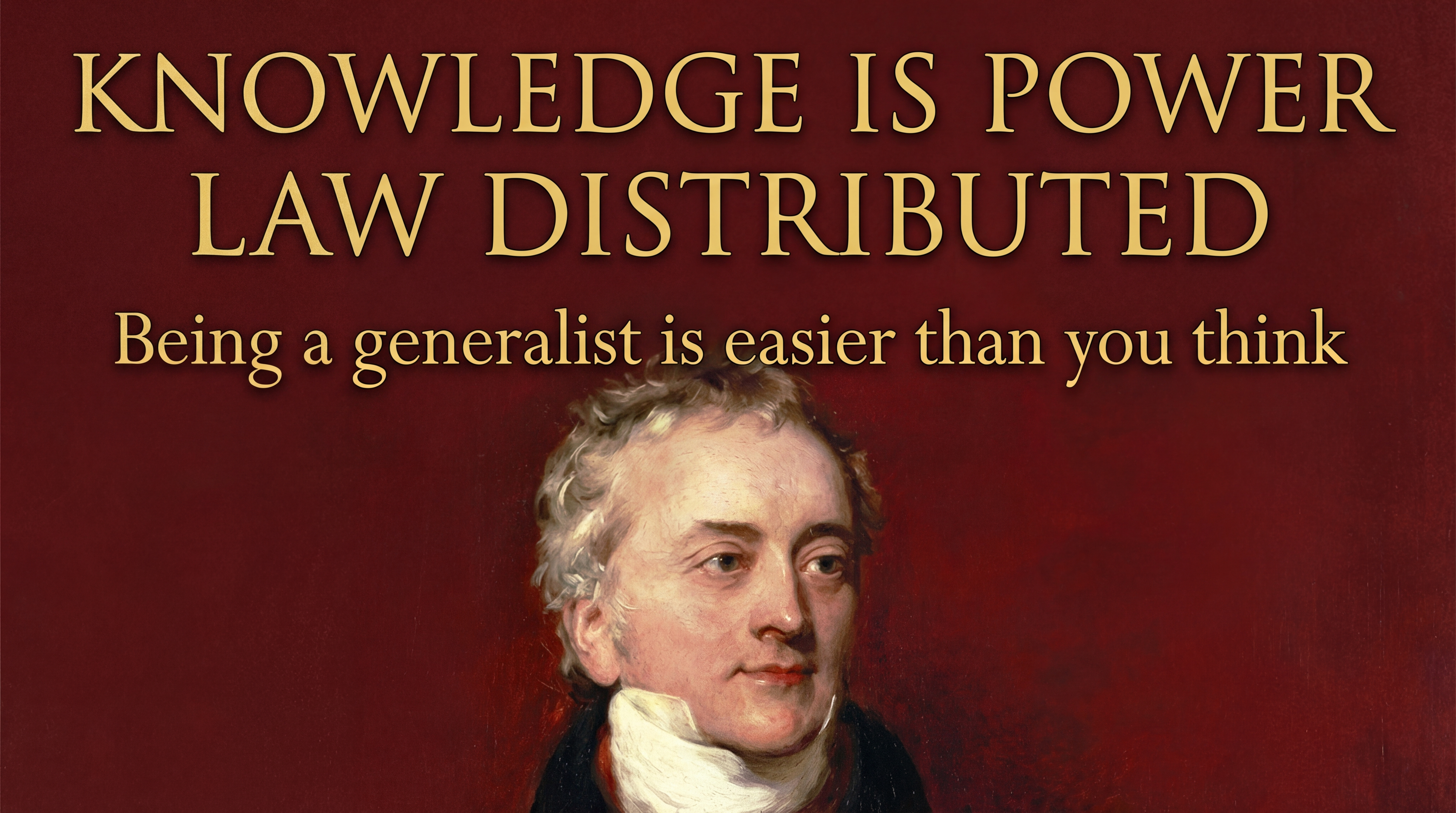
There is a common meme called “the last person who knew all of X”. Some variants include:
“The last person who knew everything” — often referring to Thomas Young (1773-1829)
“The last person who knew all of math” — often referring to David Hilbert (1862-1943)
“The last person to know all of physics” — often referring to Enrico Fermi (1901-1954)
The implication of these statements is that it is now impossible (or at least unheard of) to know everything in these domains. And the dates above show that this phenomenon of the generalist ended somewhere between 100 and 200 years ago, depending on how broadly we want to define the field of study. Thus, we have had around a century of specialization, with the idea that “becoming a true generalist is impossible” largely accepted as fact, whether explicitly or implicitly, by academics everywhere.
The march from high school diploma to undergraduate degree to PhD results in ever-greater degrees of specialization and an ever-narrowing aperture through which to view knowledge. The benefit commonly attributed to the narrowing of our education is that it helps us to reach the frontier of knowledge and thus make novel contributions more quickly. Its proponents say that no one can know everything anymore, and thus it is a waste of time to branch out to fields other than your chosen field of study.
However, my view is that we are artificially constraining our best and brightest by continuing to espouse this narrative that it’s impossible to be an effective generalist. Useful knowledge is not broadly distributed — it is concentrated in a handful of topics contained in only a handful of subjects. You can sense this intuitively if you walk through the aisles of your nearby Barnes & Noble: there are tens of thousands of books spread across the shelves, and the books on the shelves change every few weeks or months. But how many of those titles will be remembered 1 year from now? 10 years from now? What about 100 years from now? It would be a safe bet that no knowledge or insight contained in any new release will be foundational moving forward. By contrast, the knowledge contained in the core of useful books can be reapplied across different sets of facts in disparate fields to solve problems more effectively and creatively than many specialists.
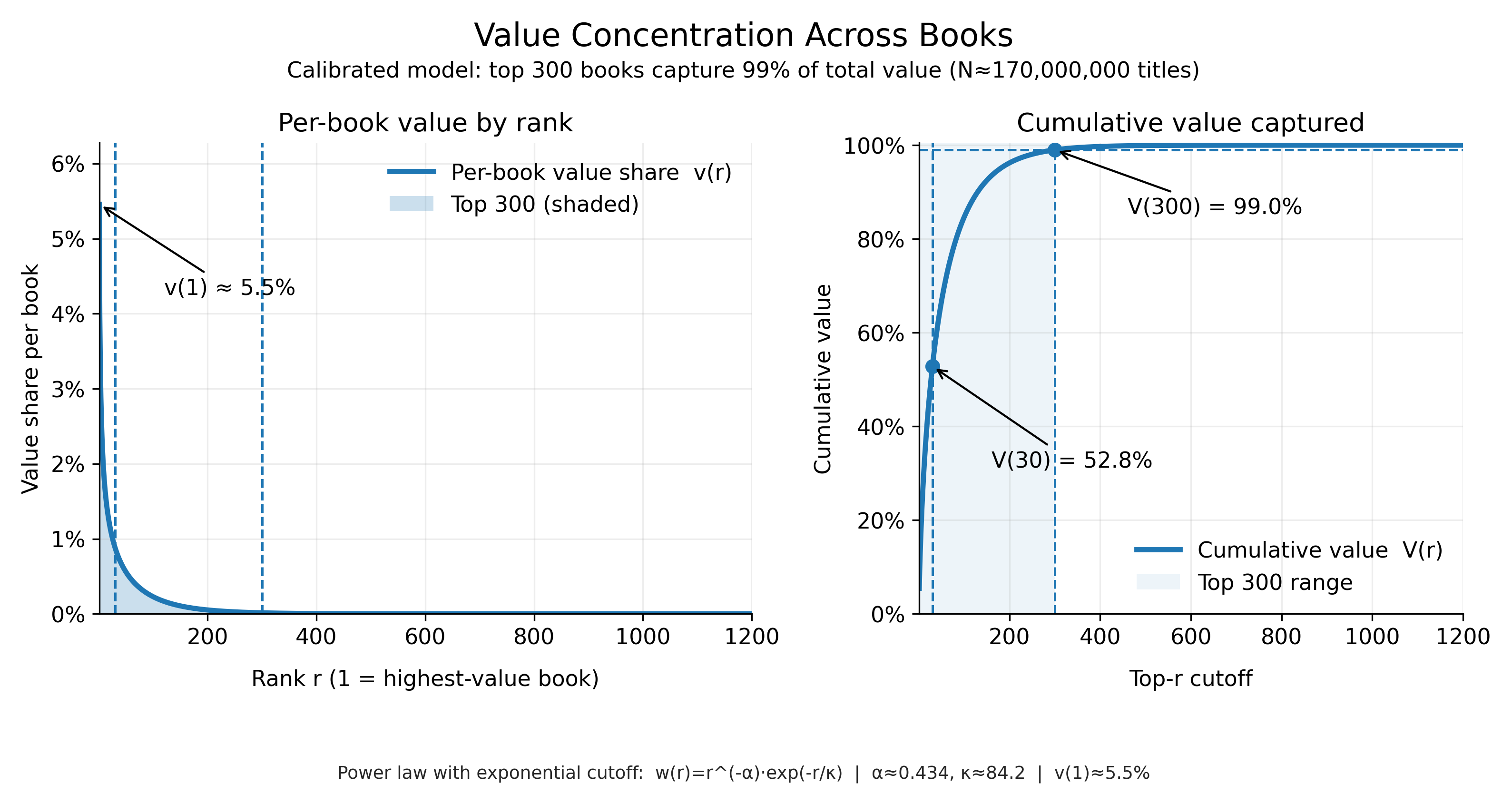
Specifically, I claim that this useful core consists of roughly 300 books of the 170 million unique titles in existence (roughly 0.00017% of all books), and that this core will afford you ~99% of the value of all knowledge ever produced. That is, if you are ~98-99th percentile 18-year-old high school graduate (roughly corresponding to ~1500+ on the SAT), then you should be able to get to the forefront of knowledge in the core academic subjects (or have the tools necessary to rapidly reach the forefront of non-core subjects) in about 300 books.
In other words, knowledge is highly power law distributed.
The core subjects that need to be learned to realize this outsized payoff consist of:
Physics
Mathematics
Computer Science
History
Philosophy
Literature (with the canon changing depending on your cultural context)
It is quite possible, within the constraints of our 300-book total, to reach the level of knowledge of a 2nd or 3rd year PhD student at an elite institution in each of these subjects. This is possible for two reasons:
Each of these fields has a small core of topics that are explored from many different angles to form the many subtopics of that field. For example, symmetries & action principles in physics, linearity & topology in mathematics, or computability & complexity in computer science.
Each of the core topics in these fields provides insight into multiple other fields in the list. Learning mathematics aids both physics and computer science (and, to an extent, philosophy). Learning philosophy aids both history and literature. And so on.
Moreover, once you have reached this level of knowledge across each of these core subjects, you will be able to dive into any subfield of these fields or any field not listed in this core and rapidly reach the frontier of research. This is only possible because other fields use the core insights of these fields as their fundamental scaffolding. Chemistry, for instance, is ultimately the study of valence electrons governed by the laws of quantum mechanics; biology is the complex chemical machinery of life; economics is the application of multivariable calculus, game theory, and psychology; and political science is the ongoing, real-world stress test of history and moral philosophy. When you own the "root nodes" of the knowledge graph, the specialized nodes are often just specific parameters applied to general frameworks you have already mastered. Consequently, the transition from this generalist foundation to a specialist frontier is not a climb up a new mountain, but a lateral step onto a bridge you have already built, allowing you to perceive structural similarities between disciplines that the siloed expert remains blind to.
Once you accept this framework, you see that learning becomes much more about curation rather than exhaustively studying all that has been published. It is the via negativa — choosing not to read a vast majority of writing so that you can instead learn a vast majority of knowledge. Thus, the barrier to becoming a modern Thomas Young is no longer cognitive capacity, nor is it the "impossibility" of the expanding universe of knowledge. The barrier is the discipline to ignore the noise of the 99.9999% in favor of the signal of the 0.0001%, and the patience to master those root nodes before attempting to climb the branches. The library of the generalist is small, but it is heavy.
End note: As an example of what this curation looks like, here is a condensed roadmap I am using to go from no knowledge of physics to a graduate school level [link]
Very interesting read! Motivating in this new year!