

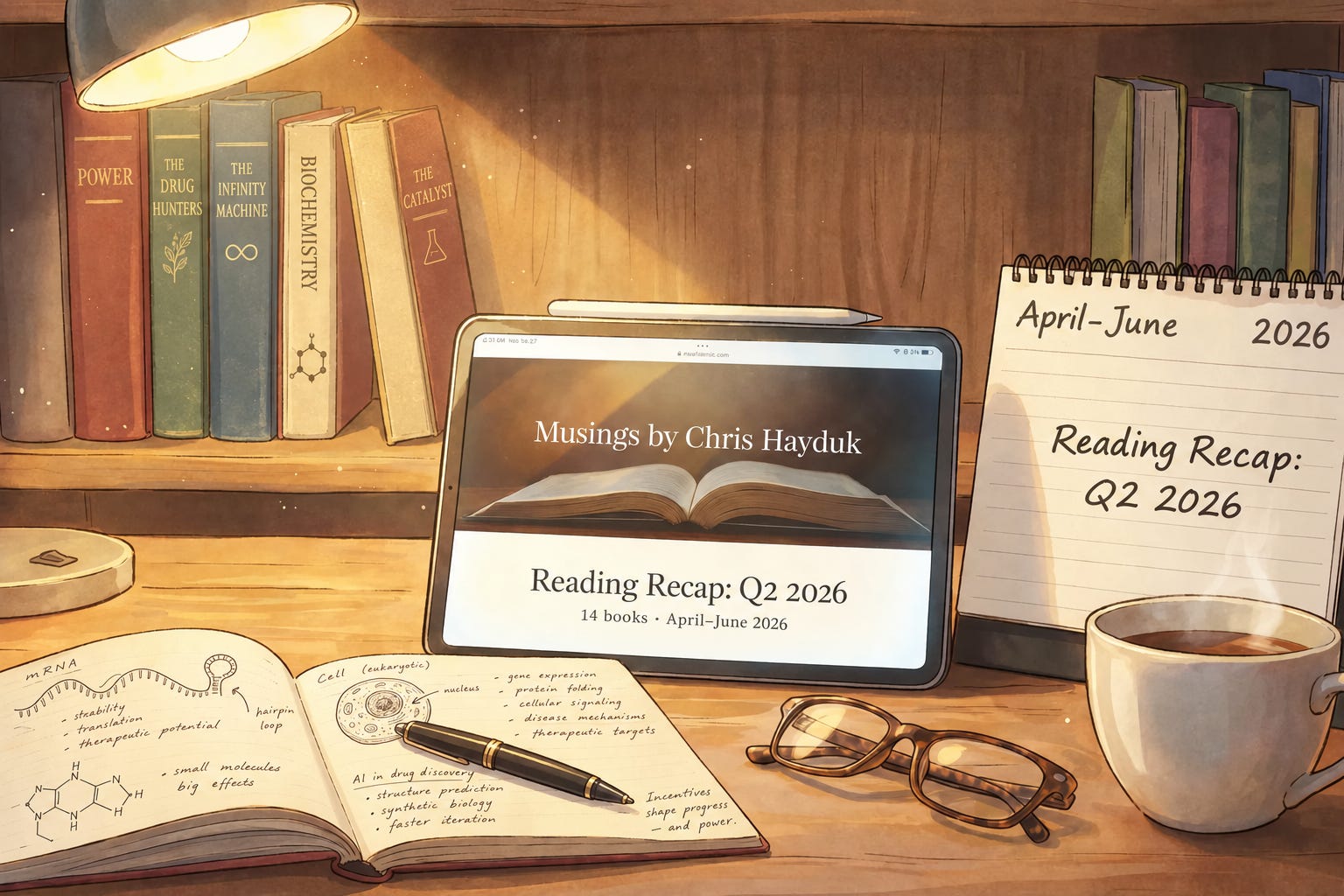
Following my Q1 reading recap, here are the 14 books I completed from April through June 2026, in chronological order.
This reading recap is coming a bit late because Q2 was a whirlwind for me! I started a new job as a Forward Deployed Engineer in Life Sciences at OpenAI, and, like a kid in a candy store, suddenly discovered I had too many awesome projects to work on and too little time.
The goal for the second quarter’s reading was to prepare myself for work in the biotech & pharma industry after 1.5 years away while working as a machine learning engineer at Meta, so you’ll see that 100% of the books were non-fiction (and mostly centered on topics related to drug discovery)!
On a separate note — with my ramping workload, I’ve found my previous approach of fitting writing in wherever I can to be inadequate. I have more to do than can reasonably be accomplished in a day, and so fitting writing in “whenever” quickly ended up resulting in “never”. I aim to do a better job of budgeting time exclusively for writing through the end of the year, so expect more consistent articles!
Now, onto the reviews and commentary.
Books
#1. Jeffrey Pfeffer, Power: Why Some People Have It―and Others Don’t (Finished April 6, 2026)
#2. Jeffrey Pfeffer, 7 Rules of Power: Surprising--but True--Advice on How to Get Things Done and Advance Your Career (Finished April 7, 2026)
Power in general is a bit of a dirty word. Almost no one likes to acknowledge that they have it, and fewer still will admit that they’d like more of it. This, I think, is the result of the word power inextricably being linked with the images of totalitarianism in our mind — a trauma response to a 20th century filled with those who sought power in order to inflict maximum harm on the world.
But harm is not all that power is good for. To illustrate this, I think the Spanish language is informative. In Spanish, poder is the word for power, but poder can also be the verb “to be able to / can". This, in my mind, captures the true nature of power — it is simply the ability to do something. Those with more of it can do more than those without it. Just as power can be used to march the globe into consecutive world wars as it was in the 20th century, it can also be used to acquire capital, hire talent, and produce lifesaving therapies. Taken thusly, power is an amoral rather than an immoral concept. Power only acquires a moral valence when the ends to which it is directed are considered.
It is from this basis that Pfeffer starts in his two books on power. Because of the negative perceptions associated with power, there is an unfortunate selection effect occurring everywhere (including in Pfeffer’s focus of the corporate world). Those who would wield power morally also feel a (misguided) moral obligation to avoid seeking power too directly, while those who would wield power immorally feel no qualms at all about pursuing it. As a result, we end up with a situation where psychopaths are overrepresented at the highest levels of business leadership.
Pfeffer’s aim in these books is to remedy this situation by convincing the moral among us that power is not, in fact, a dirty word, and then by showing clearly how to go about acquiring it.
His earlier book, Power, treats this in a more theoretical manner, explaining in general terms the sources of influences and how they develop. 7 Rules of Power, on the other hand, is much more practical — providing a step-by-step guide to being more effective in corporate roles. Both are broadly useful if you want to effect positive change in the world and find yourself falling short of your lofty ambitions!
#3. John J. Campbell, Understanding Pharma: The Professional’s Guide to How Pharmaceutical and Biotechnology Companies Really Work (Finished April 7, 2026)
An extremely clear treatment of the business and, more uniquely, the organizational structure of pharma. Each chapter addresses one org within a typical pharma, discussing its role in the business, the typical tasks it executes, the personas & roles that populate the org, and more. Strong for getting a clear picture of how the pieces fit together.
#4. Donald R. Kirsch, The Drug Hunters: The Improbable Quest to Discover New Medicines (Finished April 8, 2026)
An amazing book that reads almost as a biography of the subject of drug discovery itself. Each chapter deals with a historical approach to drug discovery and the book moves forward in roughly chronological order, taking you from the earliest days of the trial-and-error search for plants that can provide relief, all the way through to modern, molecular-targeted drug discovery.
#5. Keith Ferrazzi, Never Eat Alone: And Other Secrets to Success, One Relationship at a Time (Finished April 11, 2026)
#6. Sebastian Mallaby, The Infinity Machine: Demis Hassabis, DeepMind, and the Quest for Superintelligence (Finished April 20, 2026)
Eminently readable and throughly researched, as all Mallaby books are. For anyone working in AI, this is an extremely fun read, covering the full cast of characters we come you’re familiar with.
#7. Peter Atkins, Chemistry: A Very Short Introduction (Finished April 26, 2026)
#8. Frank S. David, The Pharmagellan Guide to Biotech Forecasting and Valuation (Finished April 27, 2026)
I find that the financial analyst’s toolkit provides a very clear set of methods by which to understand how a company works. In contrast to Understanding Pharma, which seeks to illuminate by cracking open the typical pharma or biotech org and showing how it is set up, The Pharmagellan Guide to Biotech Forecasting and Valuation (as any good financial analyst does) treats the company as a blackbox incurring costs and producing revenues. It analyzes the source of these costs and revenues, provides principles for how to forecast their changes over the lifecycle of a biotech, and ultimately gives guidance on how to turn these forecasts into valuations.
By abstracting away the structure of the company itself and focusing primarily on the sources of cost and revenue, it is possible to bring into focus the key levers that can be pulled to modify the business’s outcomes. Instead of thinking at the micro level of org charts, working group, and tasks, you can think of at the macro level of: what are the costs of my inputs? What changes have the biggest impact on return on invested capital? How does value change as I cross various milestones with a drug?
Very useful book to internalize this perspective.
#9. Nathan Vardi, For Blood and Money: Billionaires, Biotech, and the Quest for a Blockbuster Drug (Finished April 27, 2026)
The truly insane story of the development of ibrutinib, Pharmacyclics’ BTK inhibitor for treating chronic lymphocytic leukemia (CLL). This book does a great job of capturing the twists and turns, roadblocks, and drama of bringing a drug from discovery, through the clinic, and finally to market. It’s also just supremely entertaining, with amazingly colorful characters — chief among them being Bob Duggan, the eccentric CEO of Pharmacyclics who entered pharmaceuticals with no biology background and led the company to a $21 billion exit (all while peddling his Scientologist faith along the way)!
#10. Graham L. Patrick, Organic Chemistry: A Very Short Introduction (Finished May 2, 2026)
#11. Mark Lorch, Biochemistry: A Very Short Introduction (Finished May 11, 2026)
#12. Aysha Divan, Molecular Biology: A Very Short Introduction (Finished May 25, 2026)
#13. Terence Allen, The Cell: A Very Short Introduction (Finished June 19, 2026)
I’m going to use this space to provide a consolidated review of all of the A Very Short Introduction series of books listed above.
My goal with these books was to get a rapid and clear overview of the science underlying biology, starting from the most fundamental (i.e., smallest length scale) and moving upwards in size and complexity. As a result, I began with general chemistry, moving onto organic chemistry, and biochemistry. I then moved into Molecular Biology and finally Cell Biology to translate my chemistry learning into biological knowledge.
Overall I found these books to be quite high quality — they generally do a good job of touching on the most important concepts in each field, allowing you to get a tour of the core ideas in an afternoon. Obviously, given the “very short” nature (each one is only about 100-150 pages), they lack a huge amount of depth. But my goal with these was to get an orientation in the fields and identify where I could (and should) dive deep next. For this purpose they worked great, and overall I’d recommend the series if you have similar goals!
#14. Thomas R. Cech, The Catalyst: RNA and the Quest to Unlock Life’s Deepest Secrets (Finished June 24, 2026)